My Orlando Neighbor's Roof Blew Off During the Last Storm. Why Did Mine Stay On? A Roofer Explains.
The Single Biggest Factor: How Many Nails Are in Each Shingle
Four nails per shingle versus six nails per shingle
Before Florida’s post-hurricane building code revisions took effect in 2002 and were more broadly enforced after Hurricane Charley in 2004, the standard installation in Florida used four nails per shingle. Current Florida Building Code requires six nails per shingle for wind resistance in Central Florida’s wind zone. The difference sounds minor. The performance difference in a wind event is not.
Independent testing conducted after major Florida hurricane events consistently shows that shingles installed with six nails require significantly higher wind speeds to achieve uplift failure compared to shingles installed with four nails. At 70 mph sustained winds, a four-nail roof begins losing shingles. A properly installed six-nail roof at the same wind speed holds. At 90 mph, the gap widens further.
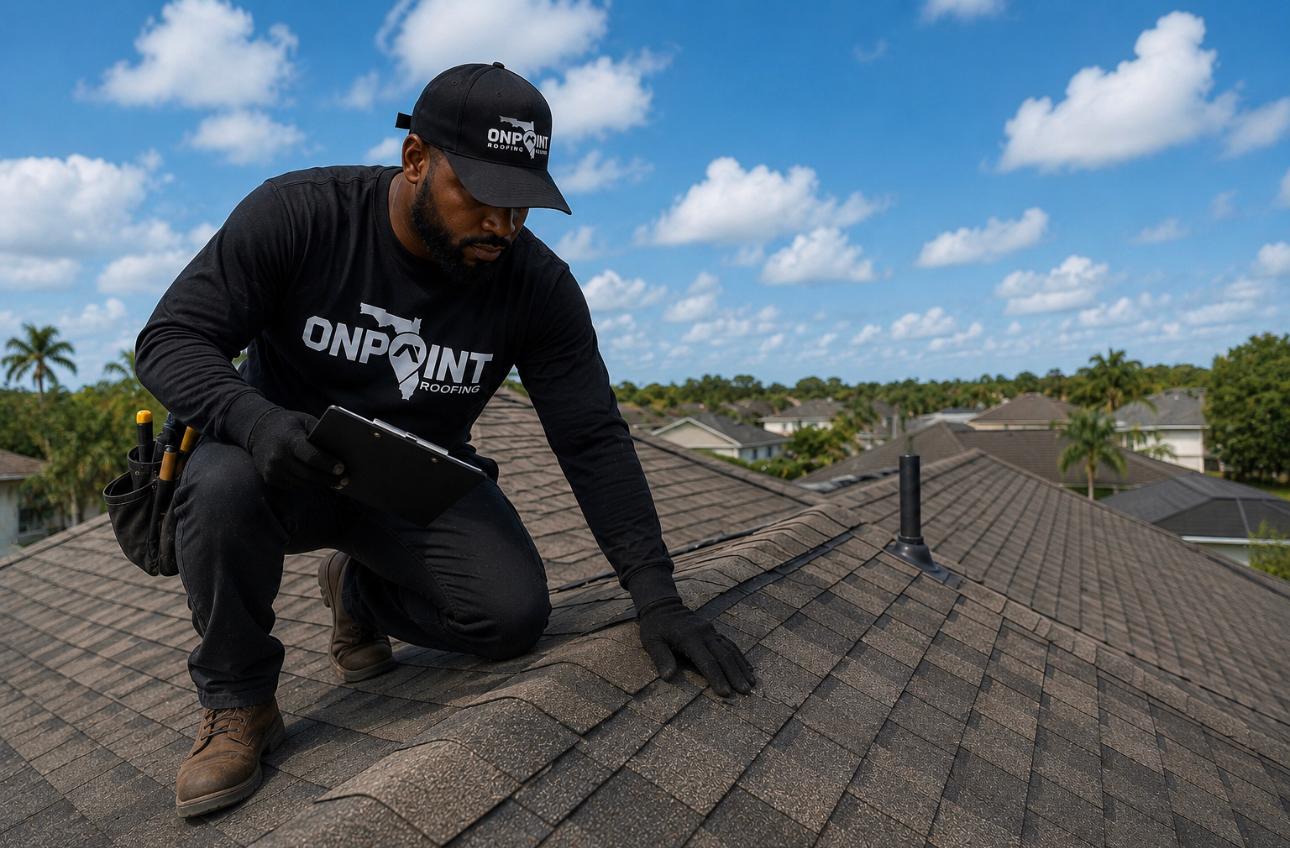
If your Orlando home was built or re-roofed before 2005 and the installation was not permitted and inspected, there is a real possibility your roof has a four-nail installation. The only way to know is a physical inspection where the inspector checks the fastening pattern on an exposed section of the roof. This is one of the specific items OnPoint Roofing checks on every inspection.
The Secondary Water Barrier. Why Roofs Built After 2008 Perform Differently
Florida Building Code adopted the secondary water barrier requirement for new residential construction and roof replacements in 2008. This requirement mandates a self-adhering membrane underlayment beneath the shingles that creates a watertight layer even if shingles are lost in a storm.
Homes built or re-roofed before 2008 typically have only felt paper underlayment beneath their shingles. Felt paper provides basic moisture resistance under normal conditions but tears quickly when exposed to wind-driven rain without shingle protection above it. Once shingles begin lifting or separating in a storm, felt paper underlayment fails within minutes under sustained wind and rain.
A roof with a secondary water barrier loses shingles in the same storm event as its neighbor but the water intrusion rate is dramatically lower. The barrier buys time. In some cases it prevents interior water damage entirely even after significant shingle loss. This is why two homes on the same street can have identical shingle loss but completely different interior outcomes after the same storm.
Every roof replacement OnPoint Roofing installs includes a secondary water barrier as required by current Florida Building Code. If your existing roof does not have one, that gap in protection becomes relevant every hurricane season.
Hurricane Straps and Clips. The Connection Most Homeowners Never Think About
The most dramatic roof failures in Florida hurricane events are not shingle loss. They are complete or partial roof structure separations where the entire roof deck or framing lifts away from the walls below it. These failures happen when the structural connection between the roof framing and the wall framing fails under wind uplift load.
What hurricane straps actually do
Hurricane straps and clips are metal connectors that fasten each rafter or truss to the top plate of the wall below it. They transfer the wind uplift force from the roof framing down through the wall structure and into the foundation rather than allowing the uplift force to simply pull the roof off the top of the walls. Homes built to pre-2002 standards in Florida often relied on toe-nailing, where the rafter was simply nailed at an angle into the top plate, rather than metal strap connectors.
The difference between toe-nailed and strap-connected roof framing at 100 mph wind is not incremental. Toe-nailed connections can fail suddenly and catastrophically. Strap-connected framing distributes the load and has a significantly higher threshold before failure. This is why homes built after Florida’s 2002 code revisions perform noticeably better in major wind events than homes of the same age built just before those revisions took effect.
How to know what your Orlando home has
If your Orlando home was built after 2002 and was permitted, it almost certainly has hurricane straps or clips. If it was built before 2002, the presence of straps depends on whether the original builder used them voluntarily or whether they were required by a local amendment to the state code at the time. A licensed contractor can check strap presence from the attic. This is one of the items our inspection team specifically assesses when evaluating a home’s hurricane readiness.
Roof Age. Why a Five-Year-Old Roof and a Twenty-Year-Old Roof Behave Completely Differently in the Same Storm
Age is the factor that most predictably separates roofs that survive storm events from roofs that do not. Here is what changes in an Orlando asphalt shingle roof as it ages through Florida’s climate:
Adhesive strip failure
Every asphalt shingle has a factory-applied adhesive strip along its bottom edge that bonds to the shingle below it after installation. This bond is what holds the shingle down in wind between the fastening nails. In Florida’s heat, this adhesive softens, re-bonds, softens again, and re-bonds over hundreds of heat cycles across a decade or more. On a roof over 15 years old, many of these adhesive bonds have partially or fully failed. The shingles are held only by their nails. In a wind event, they lift significantly easier than shingles on a newer roof with intact adhesive bonds.
Granule loss and UV brittleness
Granules are the protective surface layer on asphalt shingles. Florida’s UV intensity strips granules faster than in cooler climates. As granules are lost, the asphalt mat beneath them is exposed to direct UV radiation and becomes brittle. A brittle shingle does not flex under wind load. It cracks. A cracked shingle lets wind get under it and creates a failure point that propagates across adjacent shingles rapidly.
Fastener backing out
In older roofs, nails gradually work loose over years of thermal expansion and contraction. A nail that has backed out even a fraction of an inch is providing significantly less wind resistance than a properly seated nail. This is invisible from above and only detectable by a physical inspection where the inspector tests fastener seating in a representative sample of shingles.
Flashing sealant degradation
Every seal around a penetration point on your roof was originally applied with roofing sealant that had a finite lifespan in Florida’s UV and heat environment. On a roof over 10 years old, many of these sealant points have cracked or separated. They are small openings under normal rain conditions but become significant water entry points under wind-driven rain at storm intensities.
Installation Quality. Why the Same Materials Produce Different Results on Two Different Roofs
Two roofs installed in the same year with the same shingle brand can perform completely differently in a storm if the installation quality differed. Here is what separates a properly installed Florida roof from one that will underperform in a wind event:
Nail placement within the nailing zone
Each shingle has a defined nailing zone, a strip across the shingle where nails must be placed to provide the rated wind resistance. Nails placed too high on the shingle reduce wind resistance significantly. Nails placed too low can crack the shingle. Nailing zone compliance is a specific inspection point that affects wind performance and is verified during the county permit inspection on new installations.
Starter strip installation at the eave
The starter strip is the first course of roofing material along the bottom edge of the roof. It seals the bottom edge of the first course of shingles and provides critical protection against wind-driven rain entry at the eave. An improperly installed starter strip, or one that was omitted entirely by a contractor cutting corners, creates a vulnerability at the lowest and most exposed point of the roof.
Ridge cap installation
The ridge cap covers the peak of the roof and is the most wind-exposed shingle on the structure. Improperly nailed or low-quality ridge cap is consistently one of the first things lost in wind events. A properly installed ridge cap with the correct nail placement and exposure provides meaningful protection even at high wind speeds.
Deck fastening pattern
Before shingles go on, the roof deck itself must be properly fastened to the framing below. Current Florida code specifies the nail size, spacing, and pattern for deck fastening. An undersized or under-spaced deck fastening allows the deck itself to lift under wind uplift even if the shingles and straps are correct. This is a code compliance item that only a permitted installation verifies.
Roof Shape. Why Some Orlando Home Designs Handle Wind Better Than Others
The geometry of your roof affects how wind loads act on it. This is a factor homeowners cannot change after the home is built but it is worth understanding because it explains why some homes in your neighborhood consistently perform better or worse in wind events.
Hip roofs versus gable roofs
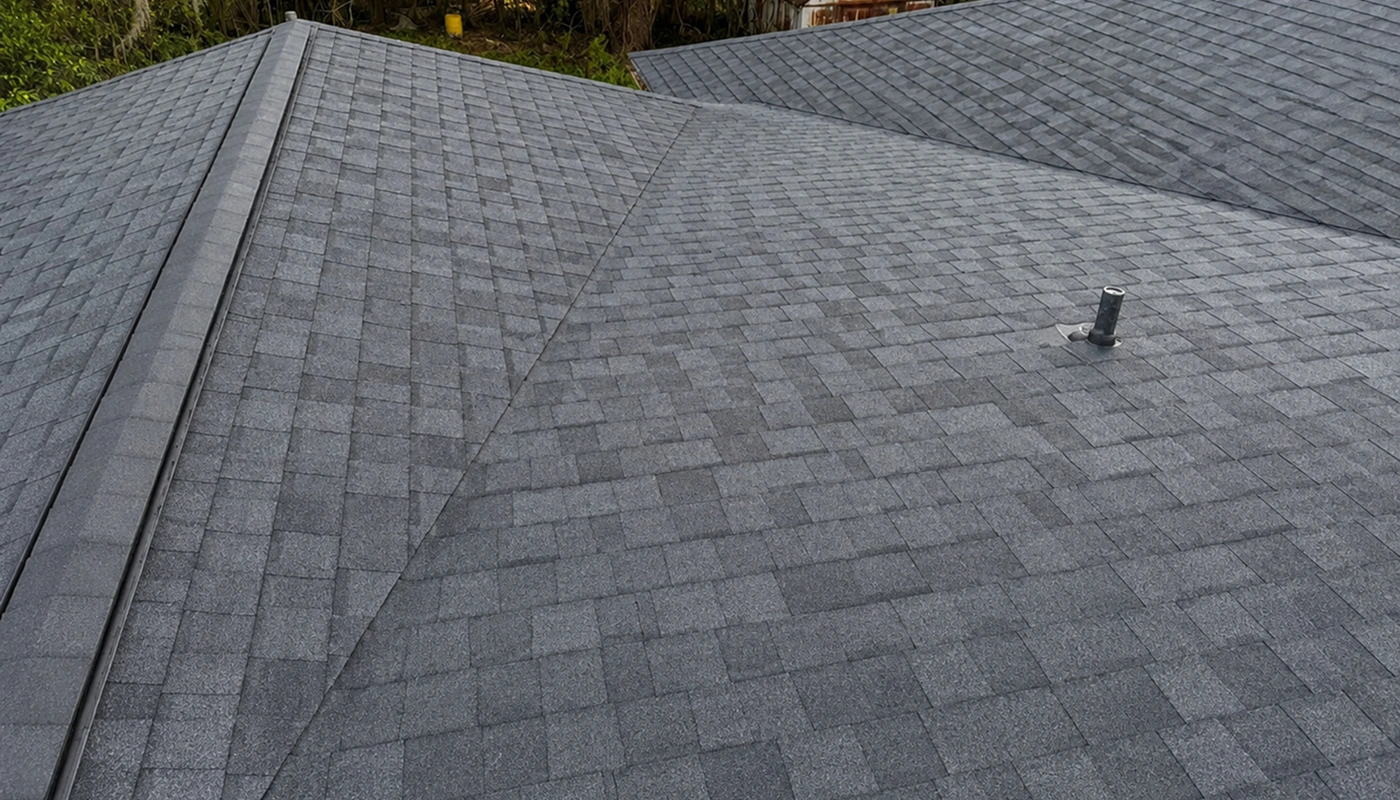
A hip roof slopes down on all four sides from the ridge. A gable roof has two sloped sides and two vertical triangular end walls called gable ends. In Florida wind engineering, hip roofs perform significantly better than gable roofs under high wind loads. The sloped surfaces on all four sides create a more aerodynamic profile that sheds wind load more evenly. Gable end walls are flat vertical surfaces that take the full force of wind loading and transfer that force to the roof-to-wall connection. Many Orlando homes built in the 1980s and 1990s have gable roof designs that create inherent wind vulnerability compared to hip roof designs.
Roof pitch and wind performance
Moderate pitch roofs, typically in the 4 in 12 to 6 in 12 range, generally perform better in wind events than very low pitch or very steep pitch roofs. Very low pitch roofs experience more wind uplift across the entire roof surface. Very steep pitch roofs catch more direct wind pressure on the windward face. The moderate pitch range balances these forces most effectively.
Overhangs and eave length
Longer eave overhangs create more surface area for wind uplift to act on at the roof edge. Homes with minimal eave overhangs have less uplift exposure at the critical edge zone where shingle loss most commonly begins.
What You Can Actually Do to Make Your Orlando Roof More Hurricane Resistant
Some of the factors above are fixed by when and how your home was built. But there are meaningful improvements available to every Orlando homeowner:
Replace an aging roof before hurricane season
If your roof is over 15 years old, a full replacement brings you current on all Florida Building Code requirements at once. Six-nail fastening pattern, secondary water barrier, properly installed ridge cap and starter strip, and a new manufacturer warranty. A replacement done before hurricane season is always less expensive and less disruptive than an emergency replacement after a storm event.
Address known vulnerabilities now
Loose flashing, cracked sealants, lifted shingle edges, and damaged ridge cap sections are all items a targeted roof repair can address before they become storm failure points. A repair that costs a few hundred dollars now is a direct reduction in your storm damage risk for this season.
Get a pre-season inspection with fastener pattern verification
If you do not know whether your roof has a four-nail or six-nail installation, or whether your attic has hurricane straps, a professional inspection tells you. OnPoint Roofing’s free inspections specifically check fastening pattern compliance, secondary water barrier presence, flashing condition, and attic strap status as part of every pre-season assessment.
Consider impact-resistant shingles on replacement
If you are replacing your roof this season, impact-resistant shingles rated Class 4 are available from both Owens Corning (Duration Storm) and GAF (Timberline AS II). These shingles carry enhanced wind and impact resistance ratings beyond the standard Florida Building Code minimum. They also often qualify for insurance premium discounts in Florida. The upgrade cost over standard architectural shingles is modest relative to the additional protection provided.
Frequently Asked Questions About Wind-Resistant Roofing in Orlando
Find Out Where Your Orlando Roof Actually Stands Before the Next Storm
OnPoint Roofing’s free inspections specifically check the factors that determine hurricane performance: fastening pattern, secondary water barrier presence, flashing condition, deck integrity, and attic strap status. We give you a written report with photos and an honest assessment of where your roof stands. No pressure, no invented problems. Just the information you need to make a smart decision before this season’s first named storm arrives.
Call or text us to schedule.