
My Flat Roof Keeps Leaking Every Time It Rains in Orlando. Is TPO Roofing the Fix?
Why Flat Roofs in Orlando Leak More Than Pitched Roofs
Standing water after heavy rain
Florida gets more rainfall than almost any other state. On a flat roof, even a slight drainage issue causes water to pond. Ponding water puts constant pressure on seams, membrane edges, and any penetration point like a drain or vent. Over time it always finds a way in.
Heat expansion and contraction
Orlando temperatures regularly push into the 90s and the roofing surface itself can exceed 150 degrees Fahrenheit in direct sun. Older flat roof materials expand and contract with every temperature cycle. That movement stresses seams and flashings until they crack or separate.
UV degradation
Florida’s sun intensity is among the highest in the country. Materials like modified bitumen and older built-up roofing absorb UV rather than reflect it. They dry out, become brittle, and develop hairline cracks that are nearly invisible until water is already inside your home.
Age and improper original installation
Many Orlando homes were built with flat sections over garages, additions, or rear extensions that were roofed with whatever was cheapest at the time. If that material is over 15 years old or was installed without proper slope engineering, it will keep leaking regardless of how many patches are applied.
What Is TPO Roofing and Why Does It Work So Well in Florida
TPO stands for Thermoplastic Polyolefin. That is the technical name for a single-ply membrane roofing system that has become the standard choice for flat and low-slope roofs across Florida over the last 15 years.
Here is why it performs so well in the Orlando climate specifically:
It reflects heat instead of absorbing it
TPO membranes are typically white or light grey. They reflect solar radiation rather than absorbing it, which keeps the roof surface significantly cooler than darker materials. In Florida, this also reduces your air conditioning load and lowers energy bills.
Seams are heat-welded, not glued
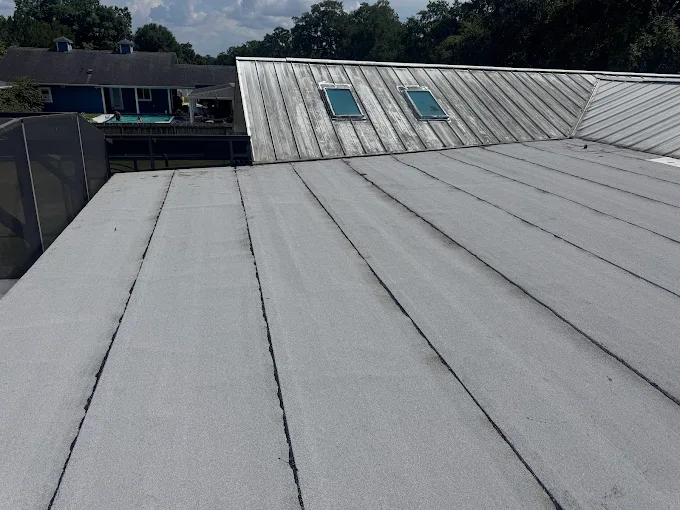
This is the biggest advantage TPO has over older flat roof materials. Seams are fused together with hot air at temperatures over 1,000 degrees Fahrenheit, creating a bond that is actually stronger than the membrane itself. Glued or self-adhered seams in older materials are always the first place water finds a way in.
It flexes without cracking
TPO is a thermoplastic material, which means it softens and flexes with heat rather than becoming rigid and brittle. This handles Florida’s temperature swings far better than materials that harden over time.
It is resistant to mold, algae, and chemical exposure
Florida’s humidity encourages biological growth on roofing surfaces. TPO resists mold and algae growth naturally and also handles exposure to oils, fats, and common rooftop chemicals better than EPDM rubber roofing.
OnPoint Roofing installs TPO roofing systems across Orlando and Central Florida. You can learn more about our TPO roofing service and what the installation process looks like for your specific roof type
TPO Roofing vs Other Flat Roof Options for Orlando Homes
Orlando homeowners often ask how TPO compares to other flat roof materials they have heard about. Here is the honest comparison:
TPO vs Modified Bitumen
Modified bitumen is a torch-applied or self-adhered asphalt-based material that was the standard flat roof solution for decades. It performs adequately in moderate climates but struggles in Florida. It absorbs heat rather than reflecting it, its seams are adhesive-based rather than welded, and it has a lifespan of 10 to 15 years in Florida conditions compared to 20 to 30 years for TPO. If your flat roof is modified bitumen and it is over 10 years old, it is almost certainly the reason you keep seeing leaks.
TPO vs EPDM
EPDM is a rubber membrane roofing system. It is durable and long-lasting but it is typically black, which absorbs heat aggressively in the Florida sun. It is also glued at the seams rather than welded, which creates a vulnerability over time. TPO is generally preferred over EPDM for Florida applications specifically because of its reflectivity and the superior welded seam system.
TPO vs Built-Up Roofing (BUR)
Built-up roofing is multiple layers of asphalt and felt or fiberglass installed in sequence. It is heavy, labor-intensive, and while durable when installed correctly, it does not perform as well as TPO in Florida’s UV environment. Most Orlando roofers have moved away from recommending BUR for residential applications.
Signs Your Orlando Flat Roof Needs TPO Replacement (Not Just Another Patch)
Patching a flat roof that is at the end of its life is one of the most common money traps in residential roofing. If you recognize more than two of these signs, a full TPO replacement will cost you less over the next five years than continued repairs
You have had the same area patched more than once
A patch that keeps failing is not a patch problem. It is a substrate problem. The material underneath is no longer holding and the leak will keep returning until the membrane is replaced.
Visible bubbling or blistering on the roof surface
Bubbles under a flat roof membrane mean moisture has already entered between the membrane and the deck. This is not repairable with a patch. The membrane needs to come off and the deck needs to be assessed before a new system goes down.
Water stains on ceilings that appear even without heavy rain
Condensation pooling or very slow leaks show up as stains after moderate rain or even during humid periods. This usually means the membrane has micro-failures across a wider area.
The roof material is over 15 years old
Regardless of visible condition, a flat roof membrane in Florida that is 15 years or older is approaching or past its expected service life. An inspection will confirm it but replacement should be in your near-term plan.
Seams that have lifted or separated
If you can see gaps, curling edges, or lifted seams on your flat roof from the roofline, water is already getting underneath during every rain.
What TPO Roofing Installation Looks Like on an Orlando Home
Most Orlando homeowners have never seen a TPO installation before. Here is what the process looks like from start to finish:
1. Inspection and deck assessment
Before any new membrane goes down, we inspect the existing roof deck for moisture damage, soft spots, and structural integrity. Any compromised decking is replaced before installation begins. Putting a new membrane over a damaged deck is the same mistake that caused the original problem.
2. Old membrane removal
The existing flat roof material is stripped back to the deck. We do not install over old material. Doing so traps moisture and voids the manufacturer warranty on the new TPO system.
3. Insulation board installation
A layer of rigid insulation board is installed over the deck before the TPO membrane. This improves energy efficiency and creates the proper surface for the membrane to bond to.
4. TPO membrane installation and welding
The TPO membrane is rolled out and mechanically fastened or fully adhered depending on the roof specification. All seams are then heat-welded using a hot-air welding machine. Every seam is tested for integrity before the job is complete.
5. Flashing and edge detail
All penetrations, drains, vents, and roof edges get custom-fabricated TPO flashing. This is where most cheap installations fail. Properly detailed flashings are what make a TPO roof genuinely watertight.
Frequently Asked Questions About TPO Roofing in Orlando
Yes. Any full roof replacement in Florida including flat roof systems requires a permit. OnPoint Roofing handles all permitting as part of every installation. Not sure if you need a full TPO replacement or just a flat roof repair ? A free inspection will give you a clear answer without any obligation.
Get a Free TPO Roofing Inspection in Orlando
If your flat roof has been leaking, patched more than once, or is simply getting old, the answer is almost always a proper TPO installation rather than another temporary fix. OnPoint Roofing inspects, quotes, and installs TPO roofing systems across Orlando and Central Florida with full permitting and Florida Building Code compliance.
Call or text us to schedule your free inspection